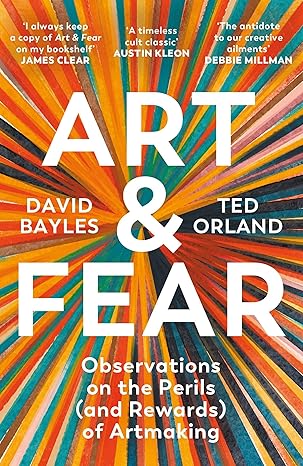
Featured Image: Art & Fear: Observations on the Perils (and Rewards) of Artmaking : Bayles, David, Orland, Ted, Mann, Sally: Amazon.ie: Books
Competitiveness vs. Creativity
I want to share something that has shaped much of my life—something you may recognise in yourself as well: competitiveness.
I was born in 1942, near the end of the Great War. My earliest memories didn’t fully take shape until I was about six or seven, but when they did, they centred around growing up without a father. He was serving overseas as a pilot during the war, and my mother was left to raise four young children on a military pension. Poverty was a constant companion.
My mother’s life had already been marked by deep tragedy. She lost her own mother at twelve and was left with an alcoholic father and older brother. Her youngest brother was killed in the North Africa Campaign at nineteen. When her father died a few years later, she was considered an orphan. My father married her to keep her from being placed in an orphanage. After all she had endured, she too eventually turned to alcohol.
School offered little refuge. I was punished almost daily—labelled a dreamer, inattentive, and lazy. Only decades later did I learn I had ADD and dyslexia.
Growing up in that environment left me with powerful fears: abandonment, rejection, and a deep belief that I wasn’t good enough. Those fears pushed me to try to outdo everyone around me. I wasn’t a top student, but I excelled in sports and later became a successful entrepreneur. Competitiveness became my armour—and my driving force.
But that armour came with a cost. I grew arrogant, assertive to a fault, and often aggressive. I hardened my heart and lost patience, compassion, and understanding. Over time, I paid dearly for that attitude—through a failed marriage and several business setbacks.
Eventually, I began to rise above that old version of myself. Through spiritual work and personal growth, I started to soften. Yet the demons of competitiveness—and the deeper demon of inadequacy—held on tightly.
Recurring dreams and nightmares eventually led me to understand the true roots of my struggle: fear of abandonment, rejection, failure, and not being enough. Facing these fears has changed the way I live and behave. For the first time, I feel a genuine sense of peace.
It was in this state that my writing creativity came alive. This experience is like discovering gold – what a blessing! For me, it is a healing salve over long-standing wounds.
A book I read, ‘Art & Fear’, presented a less personal view through the lens of ‘A View into the Outside World.’
I thought you might enjoy and be enlightened by this piece appearing on page 75.
Competition
A View Into The Outside World.
There is no denying competition. It’s hard-wired into us. It’s chemical. Good athletes bank on that surge of energy that arises in the instant of knowing they can overtake the runner just ahead. Good artists thrive on exhibit and publication deadlines, on working 20 hours straight to see the pots are glazed and fired just so, on making their next work better than their last. The urge to compete provides a source of raw energy, and for that purpose alone, it can be exceptionally useful. In a healthy artistic environment, that energy is directed inward to fulfill one’s own potential. In a healthy environment, artists are not in competition with each other. Unfortunately, healthy artistic environments are about as common as unicorns. We live in a society that encourages competition at demonstrably vicious levels and sets a hard and accountable yardstick for judging who wins. It’s easier to rate artists in terms of the recognition they received (which is easily compared) than in terms of the pieces they’ve made (which may be as different as apples and waltzes). And when that happens, competition centres not only on making work, but on collecting the symbols of acceptance and approval of that work – NEA grants, a show at Galerie du Jour, a celebrity profile in The New Yorker, and the like.
Taken to extremes, such competition slides into needless (and often self-destructive) comparison with the fortunes of others. WC fields became enraged at the mere mention of Charlie Chaplin’s name, Milton suffered lifelong depression from ongoing self-comparison with Shakespeare, Saleri went a bit more insane each time he compared his music to Mozart’s. (and who among us would welcomethat comparison?) Fear that you are not as good as a fellow artist leads to depression.
See you next monthe, same date same place.
Love and Blessings.
Peter-James.
Art & Fear: Observations on the Perils (and Rewards) of Artmaking

 Love Your Life Adopt Your Purpose
Take the leap to comment, I personally respond to each.