My birth name is Peter James Pienaar. A perfectly respectable name, I think. But if I had arrived a few centuries earlier, somewhere around 1555, and if history had been a little kinder with titles, trumpets, and velvet cloaks, I might have been introduced as Lord Peter James.
There are records linking the old Pinard surname with British peerage and the long business of hereditary titles and noble rank. Very grand, all of it.
So yes, in another life you might have found yourself seated beside Lord Peter James at dinner. But please, no bowing, scraping, or curtseying when you see me. Our actual root was not lounging about in a castle. Jacques Pinard (circa 1662) was born in France and worked as a simple carpenter, which is probably far more useful than being a lord anyway.
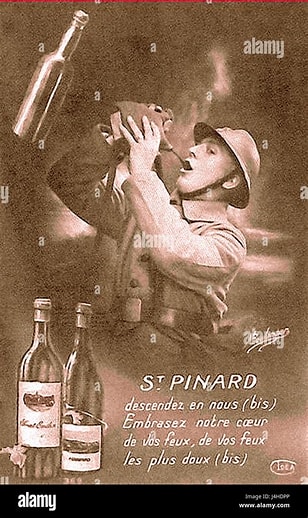
During the First World War, French soldiers in the trenches had their ration of red wine, affectionately called pinard, and somewhere along the line it was elevated to the status of “Saint Pinard.” Trust the French to find a patron saint for a bottle.

To this day, Domaine Vincent Pinard in Sancerre continues to produce fine wines. Whites, reds, even a rosé. So, if there is nobility in the family tree, perhaps it is not in the peerage after all, but in the bottle.

Now, you may well ask, what is the connection between Pinard and Pienaar? Thanks to my younger brother and an uncle of ours, our family line has been traced back, in one straight line, to 1688. My uncle, years ago, changed his name from Pienaar to Pinard to help his political aspirations along. Whether the name did the heavy lifting, I cannot say.
My brother did the same, but for a different reason. He felt it was best to go back to the family’s original name.
I was planning to do the same until my father said, “Over my dead body you will.” So I didn’t. A few years later, he died, but by then I had lost interest, which shows that timing is everything in genealogy.
Original name, you ask? Yes. In 1688, a certain Jacques Pinard arrived in Cape Town with his wife, Esther, and their children. He bought a farm and named it ‘Wagenmakersvallei Leeuwen Tuin,’ which translates rather splendidly as

Poster produced by ChatGPT paying tribute to fine wines produced by thefamily Vincent Pinard Sanscerre.
“Wagonmakers Valley Lion’s Den.” You have to admire a man who arrives in a new country and gives his farm a name with that much confidence.
Jaques eldest son, Jacobus, then changed his name to Pienaar. There is no neat little note in the family records saying why, which is inconvenient of our ancestors, I think, but perhaps the reason lay in what Jacques himself had been through.
While still in France, Jacques Pinard had been forced by the King’s dragoons to renounce his faith on 15 November 1685 in the Saint-Pierre Catholic Church of Dreux. He and his young wife, Esther, fled to the Netherlands, and from there they boarded a ship for Cape Town, South Africa. After Esther’s death, Jacques married Marthe Lefebvre. Jacques and his two wives laid the foundations of the Pienaar family.
The family did not remain quiet after that. Firstly, there was the famous ‘Colonel Flippie Pienaar’, a leader in the Boer War forces in 1901 and later appointed as the South African representative to Portugal in 1939. His cousin, General Daniël “Dan” Pienaar (1893–1942), commanded the First South African Brigade during the North African campaign in the Second World War. Capt. R.C. ‘Danny’ Pienaar (my father) flew his crew from Durban, South Africa, to Cairo, bringing troops from that battle back home in their Sunderland flying boat ‘J…RB.’
In contemporary times, Francois Pienaar, born in 1967, led the Springboks to victory in the 1995 Rugby World Cup final. After years of South African rugby being kept out of the international game for political reasons, that win meant far more than a trophy. It helped put the Springboks back on the world stage and into the top position they hold today. Francois helped set the pace for what they would become. There is Stephen Pienaar, a top soccer player who played for several English clubs throughout his career.
And somewhere among all the bruhaha of world affairs, in the summer of ’42, young Peter-James Pienaar arrived in this world sans any titles.
And there you have it, folks — my roots. A little noble, a little French, a little wine-soaked, and, thankfully, still standing.


Leave a Reply